

Low-slope systems integrate easily into secondary structures extending off the main house, but whole-home flat roofs carry real risks in a climate that averages 35 to 45 inches of snowfall per year and repeated temperature changes that stress roofing materials season after season. The right answer depends heavily on what structure you’re roofing and how that structure handles snow, drainage, and moisture over time.
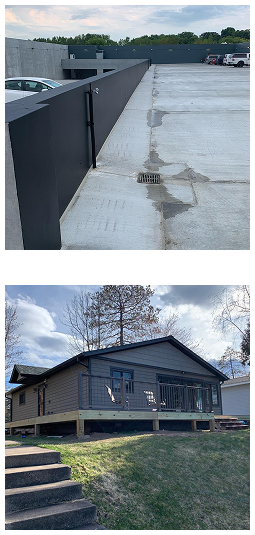
In the Madison area and surrounding south-central Wisconsin communities, flat and low-slope roofs show up most often on room additions, attached garages, sunrooms, and covered porches. Some ranch-style and contemporary-style homes also use low-slope designs across part or all of the roofline. These applications can perform well when the system is properly designed and installed for the local climate.
What Are the Real Pros and Cons of a Flat Roof on a Residential Home?
Flat roofs cost less to install than pitched systems, roughly $4 to $8 per square foot versus $5 to $12, but that upfront savings brings notable trade-offs. In a climate like south-central Wisconsin’s. Understanding the flat roof pros and cons for residential homes before you commit can save thousands in repair costs down the road.
| Pros | Cons |
|---|---|
| Lower installation cost of $4 to $8 per square foot | Ponding water can develop within 48 hours of a rainstorm |
| Easier placement of HVAC units and solar panels | Higher maintenance frequency than pitched roofs |
| Usable rooftop space for roof decks or equipment | Poor snow-shedding: snow and ice accumulate and add stress |
| Simpler access for inspections and minor repairs | Seams and membranes face greater stress from temperature changes |
Wisconsin’s climate makes the cons harder to ignore. Madison averages 100+ temperature changes per year, and each cycle expands and contracts roofing membranes, stressing seams and accelerating wear. For residential flat roofs in Wisconsin, that repeated movement is the single biggest factor behind early membrane failure and leak development.
Ponding water that freezes overnight adds to that damage fast.
If you’re considering a flat roof on an addition, garage, or sunroom, match the membrane choice and drainage design to the local climate before signing any contract.
How Long Does a Flat Roof Last on a House and What Affects That Lifespan?
How long a flat roof lasts on a house depends on the membrane type. EPDM, TPO, PVC, and modified bitumen each perform differently in Wisconsin’s climate, with lifespans ranging from 15 to 30 years under good conditions.
| System | Installed Cost per Sq. Ft. | Expected Lifespan (Years) | Performance in Temperature-Change Climates | Manufacturer Warranty Range (Years) |
|---|---|---|---|---|
| EPDM | $4.50 to $7.50 | 20 to 30 | Excellent | 10 to 20 |
| TPO | $5.00 to $8.50 | 15 to 25 | Good | 10 to 20 |
| PVC | $6.00 to $10.00 | 20 to 30 | Good | 10 to 20 |
| Modified Bitumen | $4.00 to $7.00 | 15 to 20 | Fair | 5 to 12 |
In Wisconsin’s real-world conditions, actual lifespan runs 15% to 20% shorter than manufacturer estimates when drainage slope falls below the minimum ¼ inch per foot required under Wisconsin Uniform Dwelling Code or when annual maintenance is skipped. Ponding water is the leading cause of premature flat roof failure in humid continental climates. Sitting water breaks down membrane adhesives, allows capillary action to draw moisture into seams, and expands when frozen, accelerating damage far faster than normal wear.
EPDM earns the strongest track record in Wisconsin’s climate because it flexes through repeated temperature changes without cracking, making it the most dependable choice for residential low-slope applications in south-central Wisconsin.
What Flat Roof Problems Should Wisconsin Homeowners Watch Out For?
Five flat roof problems to watch out for in Wisconsin’s climate account for the majority of early failures: ponding water, membrane shrinkage, ice buildup at parapet walls, seam and flashing separation, and interior condensation from poor insulation. Spotting these issues quickly keeps maintenance costs low and prevents total membrane failure.
- Ponding water after 48 hours: Standing water that remains on the surface of the roof more than 48 hours after a rainstorm signals drainage failure. Inside, look for water stains on ceilings near exterior walls, a warning sign you can spot without a contractor.
- Membrane shrinkage from temperature changes: Repeated expansion and contraction pulls membranes away from edges and gaps. Visible membrane ridging or bubbling on the surface of the roof is the warning sign to look for.
- Ice buildup at parapet walls: In January and February, ice accumulates where parapet walls meet the roof membrane, forcing water under flashings as it melts. Watch for ice ridges forming along interior roof edges during freezing weather.
- Seam and flashing separation: Seams are the weakest points on any single-ply membrane. Open or lifting seams at flashings, vents, or drains can let water in within a single rainstorm; check these visually after major storms.
- Interior condensation from inadequate insulation: Wisconsin energy code requires a minimum insulation value of R-49 for low-slope residential roof assemblies. Below that threshold, warm interior air hits the cold roof deck and condenses. Frost or moisture on interior ceiling surfaces near the roofline is the homeowner-visible sign.
Schedule a professional roof inspection twice per year, once in spring and once in fall, to catch these problems before small repairs grow into large replacements.
Flat Roof vs. Pitched Roof: Which Is Actually Better for Your Home?
Neither flat nor pitched is universally better; the right choice depends on the structure, budget, and how long you plan to own the home. Pitched roofs with asphalt shingles typically last 25 to 30 years in Wisconsin’s climate with minimal maintenance, versus 15 to 25 years for flat membrane systems that require semi-annual upkeep, making the long-term cost of ownership higher for flat roofs even when the upfront cost is lower.
- Flat roof wins on a garage addition or sunroom: Where headroom clearance and lower installation costs of roughly $4 to $8 per square foot matter more than long-term longevity, a flat system fits the structure and the budget.
- Flat roof wins when rooftop equipment placement is a priority: HVAC units and solar panels install more easily on a flat surface, and access for future service is simpler without a steep pitch.
- Flat roof wins on low-profile contemporary or ranch-style designs: Some home designs make a pitched roof impractical visually or structurally, and a properly installed low-slope system performs acceptably on partial rooflines.
- Flat roof wins when upfront cost is the hard constraint: Initial installation runs lower per square foot than most pitched roofing systems, though that gap narrows over 20 to 30 years once maintenance costs are added.
- Pitched roof wins on any primary home roof: Snow clears easier off steep-slope roofs, whereas asphalt shingles at a 4:12 pitch still hold heavy snow. That strains flat membranes through Wisconsin’s winters averaging 35 to 45 inches of snowfall.
- Pitched roof wins where 30-year longevity is the goal: Asphalt shingles on a pitched roof outlast flat membrane systems by 5 to 15 years in real-world Wisconsin conditions with far less maintenance required.
- Pitched roof wins under Wisconsin Uniform Dwelling Code compliance pressure: Low-slope assemblies trigger drainage slope requirements of a minimum ¼ inch per foot and higher insulation R-value thresholds that add design complexity and cost.
- Pitched roof wins when resale appeal matters: Most buyers in south-central Wisconsin expect a traditional pitched roof on a primary home, and flat-roofing systems on whole-home applications can raise questions during home inspections.
For primary homes in the Madison area, a pitched roof is the stronger long-term decision. Flat systems make sense on additions and accessory structures where cost and clearance drive the choice, not on whole-home applications where snow and membrane lifespan create real risk over 20-plus years.
Before finalizing any roof type, confirm that your design meets Wisconsin Uniform Dwelling Code slope and insulation requirements; low-slope assemblies in particular face code triggers that affect both drainage design and R-value minimums.
What Does a Flat Roof Cost and Is It Worth It Long-Term?
Flat roofs cost less upfront than pitched systems but over a 30-year horizon, that savings often disappears once maintenance, repairs, and one full membrane replacement are factored in. The table below compares installed costs, 30-year total cost of ownership, and break-even points versus asphalt shingles on a 1,000 sq ft roof section using realistic Wisconsin contractor pricing.
| Roof Type / Material | Avg. Installed Cost (1,000 sq ft) | Est. 30-Year Total Cost of Ownership | Break-Even vs. Asphalt Shingles |
|---|---|---|---|
| Asphalt Shingles (pitched) | $4,500 to $8,000 | $9,000 to $16,000 | Baseline |
| EPDM (flat) | $4,500 to $7,500 | $13,000 to $21,000 | Rarely breaks even over 30 years |
| TPO (flat) | $5,000 to $8,500 | $14,000 to $23,000 | Rarely breaks even over 30 years |
| Modified Bitumen (flat) | $4,000 to $7,000 | $15,000 to $25,000 | Does not break even; shorter lifespan requires two replacement cycles |
| PVC (flat) | $6,000 to $10,000 | $14,500 to $22,000 | Rarely breaks even over 30 years |
The 30-year cost figures above include semi-annual professional inspections at $150 to $300 per visit, minor repairs averaging $300 to $800 per occurrence, and one full membrane replacement on the 1,000 sq ft section, typically $5,000 to $12,000 depending on material. Those recurring costs are what erode the upfront savings.
Flat roofs on additions and garages can deliver real value when upfront cost savings run 20% to 35% versus a pitched retrofit, but whole-home flat roof replacement rarely breaks even against a quality shingle system over a 30-year horizon in Wisconsin’s climate. For additions and accessory structures, flat is often the smarter financial call. For primary home roofs, the numbers favor pitched systems every time.
How Do You Keep a Flat Roof in Good Shape Year After Year?
The best flat roof maintenance tips for homeowners follow a three-point schedule: spring, fall, and post-storm, because catching problems early can save thousands in remediation costs. Clearing a clogged drain takes minutes; ignoring it can lead to ponding-related failures that cost $2,000 to $5,000 to fix.
- Spring inspection check seams, flashing, and drainage: After winter temperature changes, inspect every seam, flashing, and roof drain for separation or blockage. Catching a seam separation early runs about $200 to $400 in residential roof repair; left alone, the resulting interior water damage averages $3,000 to $10,000 in remediation.
- Fall inspection: clear drains and check membrane condition: Clear all roof drains before the first freeze. Look for membrane shrinkage or pulling at edges. Blocked drains are the most common cause of ponding, which breaks down membrane adhesives within 48 hours of standing water.
- Post-storm check after hail or winds above 50 mph: Walk the roof after any storm with hail or winds exceeding 50 mph. Look for punctures, lifted flashings, and displaced seams; damage that gets worse fast in the next rainstorm if left unaddressed.
- Document every inspection with photos: Take dated photos of the surface of the roof, seams, drains, and flashings at each visit. A written maintenance log with photos supports manufacturer warranty claims and can reduce disputes during homeowners insurance claims.
Two inspections per year plus a quick post-storm walkthrough costs almost nothing and keeps small, inexpensive repairs from turning into the kind of water damage that empties a savings account.
Ready to Find Out if a Flat Roof Makes Sense for Your Home?
Choosing the wrong roof type on a primary home can add $5,000 to $12,000 in unexpected costs over a single membrane’s lifespan, and a professional evaluation before you commit can prevent exactly that. Badgerland Property Service serves homeowners across Dane, Columbia, Sauk, and Rock counties, including Madison, Waunakee, Sun Prairie, Verona, and surrounding communities.
A free roof assessment covers drainage slope, insulation requirements, and material fit for your specific home so you get a clear answer before spending a dollar.
Schedule your free roof assessment.
Not ready to schedule? Learn more about flat roof installation and repair.